

The Ultimate Guide to the Comfort Zone: What It Is and How to Break Free
Most people hear the phrase “comfort zone” and assume they already know what it means.
- It’s where you feel safe.
- It’s where life feels familiar.
- It’s where you avoid risk.
And the advice is almost always the same:
Get out of it.
But that advice often leaves out an important piece of the puzzle.
The truth is, the comfort zone isn’t just a place you step out of. It’s a psychological system that influences how you think, make decisions, and respond to everyday situations.
More importantly:
You don’t leave your comfort zone once and never return. Instead, you gradually expand it over time, one small step after another.
In this guide, I’ll explain what the comfort zone really is, why it feels so powerful, why so many people remain stuck in it, and how you can break free in a way that creates lasting change.
This post contains affiliate links, which means we may earn a commission if you purchase through our links—at no extra cost to you. As an Amazon Associate we earn from qualifying purchases. We only recommend products we use or trust. Learn more about affiliate marketing or read our full disclosure.
What the Comfort Zone Actually Is
The comfort zone is a psychological state where your behavior feels:
- Familiar
- Predictable
- Low-risk
- Emotionally stable
Found this helpful? Pin it for later so you can come back anytime.

It’s the space where life feels familiar and manageable, even if it isn’t perfect.
It includes:
- Your daily routines
- Your habits
- Your social interactions
- Your thought patterns
- Your coping strategies
And it isn’t always about feeling happy or satisfied. Even parts of your life that aren’t ideal can still feel “comfortable” because they’re familiar and predictable.
That’s an important point to understand:
Familiarity is one of the most powerful forces in human psychology.
RELATED POST: Why Most People Never Leave Their Comfort Zone
Why Your Brain Builds a Comfort Zone
Your comfort zone isn’t a weakness or a personality flaw. It’s a survival mechanism.
Your brain is constantly trying to:
- Reduce uncertainty
- Conserve energy
- Avoid perceived threats
- Predict outcomes
From an evolutionary perspective, unpredictability often meant danger. As a result, your brain developed a strong tendency to think:
- Familiar = safe
- Unfamiliar = risky
That’s why your brain doesn’t naturally prioritize growth. Instead, it prioritizes stability and predictability.
Even positive changes can feel uncomfortable because they introduce uncertainty and disrupt what your brain already knows.
That’s also why you often feel resistance when you try to grow or do something new. It’s not because growth is bad, but because it’s unfamiliar—and your brain is wired to approach unfamiliar situations with caution.
RELATED POST: Why Getting Out of Your Comfort Zone Feels So Hard
Why Staying in the Comfort Zone Feels So Easy
Staying in your comfort zone feels easy because it requires:
- Less decision-making
- Less emotional effort
- Less uncertainty
- Less risk
Your brain naturally prefers efficiency, and familiar behaviors are already “optimized” in that sense—you don’t have to figure them out from scratch every time.
For example:
- You already know how your routine will play out
- You already know how it’s likely to make you feel
- You already know the range of outcomes to expect
That level of predictability reduces mental effort. There’s less guessing, less evaluating, and fewer surprises to deal with.
So even if your comfort zone isn’t completely satisfying, it can still feel efficient and manageable in the moment.
And in the short term, efficiency often wins over improvement simply because it asks less of you right now.
The Hidden Cost of Staying in Your Comfort Zone
The comfort zone isn’t automatically harmful.
But staying there for too long can come with a hidden cost:
Stagnation.
While your inner world feels stable, the world around you keeps moving forward—and it doesn’t automatically slow down to match your comfort zone.
Over time, this can lead to:
- Lack of progress
- Frustration
- Missed opportunities
- Reduced confidence
- A general feeling of being “stuck” in life
The most important thing to understand is that this rarely happens all at once. There’s usually no single moment when everything suddenly changes or falls apart.
Instead, progress slows little by little… until one day you realize you haven’t really moved forward in a long time.
Why It’s Hard to Leave the Comfort Zone
Leaving your comfort zone is difficult for several psychological reasons, and they often work together to keep you where you are:
1. Uncertainty Feels Threatening
Your brain prefers predictable outcomes because they feel safer and easier to manage.
When you try something new, you don’t know exactly what will happen, and that uncertainty naturally creates resistance.
It’s not necessarily because the new situation is dangerous. It’s because your brain can’t confidently predict what comes next, and that uncertainty alone can make you hesitate.
If you notice that your own thoughts often become the biggest obstacle to change, the Switch Research Self-Talk Journal (available on Amazon) can help you identify and challenge the internal narratives that keep you stuck.
2. Effort Feels Expensive
New behaviors require:
- Energy
- Focus
- Emotional tolerance
Because of this, your brain tends to see them as “costly.”
Even if something could benefit you in the long run, it still has to compete with your brain’s natural instinct to conserve energy.
That’s why unfamiliar actions often feel harder, slower, and more demanding than simply sticking with what you already know.
3. Fear of Failure
Even small risks can feel much bigger when the outcome is uncertain.
When you step outside your comfort zone, there’s no guarantee of how things will turn out. In response, your brain often fills that uncertainty with worst-case scenarios.
As a result, the possibility of failure can feel far more intimidating than the situation itself.
Found this helpful? Pin it for later so you can come back anytime.

4. Fear of Discomfort
Growth almost always involves some temporary discomfort:
- Awkwardness
- Confusion
- Mistakes
- Emotional strain
These experiences are a normal part of learning and growing, but your brain often interprets them as signs that you should pull back.
As a result, it naturally tries to avoid situations where those feelings might arise, even when the long-term outcome would be positive.
5. Identity Resistance
If a behavior doesn’t fit with how you see yourself—for example, “I’m not that kind of person”—your brain will often resist it.
When something feels out of alignment with your identity, it can seem unnatural or forced, even if it’s clearly positive or beneficial.
That sense of internal conflict alone is often enough to make you hesitate or avoid taking action.
All of these factors work together, reinforcing one another and making it feel easier to stay in your comfort zone than to leave it—even when stepping outside it would clearly improve your life.
For a deeper look at why people resist change even when they genuinely want it, The Mountain Is You by Brianna Wiest (available on Amazon) explores the patterns of self-sabotage that often keep personal growth out of reach.
RELATED POST: What Really Happens When You Step Out of Comfort Zone
Your Comfort Zone Can Expand or Shrink
One of the biggest misconceptions about the comfort zone is that it’s fixed.
It isn’t.
Your comfort zone changes over time based on how you respond to different situations and experiences.
When you consistently avoid discomfort:
- Your comfort zone gets smaller
- More situations begin to feel challenging
- Resistance shows up more quickly and more often
When you take small, consistent actions:
- Your comfort zone expands
- New behaviors start to feel natural
- Life feels more flexible and less limiting
- What once felt unfamiliar gradually becomes familiar.
So the goal isn’t really to “escape” your comfort zone completely. It’s to expand it, one step at a time, until more of life feels manageable, familiar, and within your reach.
The Real Meaning of “Growth”
Growth isn’t a dramatic overnight transformation. In reality, it’s much simpler—and much more repetitive—than that.
It’s repeated exposure to discomfort until it begins to feel familiar.
In other words, the things that once felt difficult gradually become part of your normal life through consistency and repetition.
For example:
- Speaking in public
- Exercising regularly
- Waking up early
- Learning new skills
All of these usually feel uncomfortable at first—until, over time, they don’t.
And that’s really what growth is all about:
Turning the unfamiliar into the familiar.
Similar ideas are explored in Mindset by Carol Dweck (available on Bookshop.org), which explains how seeing your abilities as something you can develop, rather than something that’s fixed, can make it easier to embrace challenges and personal growth.
book tip

Mindset: The New Psychology of Success
By Carol S. Dweck
Do you believe your abilities are fixed, or that you can grow with effort?
Did you know? When you buy through Bookshop.org, you’re helping support independent bookstores.
How to Break Free From the Comfort Zone (Without Overwhelm)
Most people struggle to leave their comfort zone because they try to do too much, too quickly.
They aim for:
- Huge changes
- Instant transformation
- High-pressure goals
But that approach often backfires because it creates too much resistance all at once, making it much easier to give up.
Instead, the key is gradual expansion.
Step 1: Start Smaller Than You Think You Need To
One of the most common mistakes people make is trying to start too big.
Instead of saying:
I will completely change my routine.
Try something much smaller and easier to manage:
I will do 5 minutes of the new behavior.
Small actions reduce resistance because they feel safe, simple, and easy to start. And when something feels easy to begin, you’re much more likely to follow through.
If you’re interested in making small changes that actually last, Atomic Habits by James Clear (available on Bookshop.org) offers practical strategies for building lasting behaviors through consistency rather than motivation.
book tip

Atomic Habits
By James Clear
Want to change your life without relying on willpower?
Did you know? When you buy through Bookshop.org, you’re helping support independent bookstores.
Step 2: Focus on First Actions, Not Outcomes
Your brain often resists outcomes because they can feel big, distant, and uncertain.
But it usually doesn’t resist small, immediate actions like:
- Opening a document
- Putting on workout clothes
- Writing one sentence
These steps feel manageable because they exist in the present moment, not in a future result that still feels far away.
So rather than focusing on the end goal, focus only on the very next physical action you need to take.
Step 3: Expect Resistance (It’s Normal)
Resistance isn’t a sign that something is wrong. It’s a sign that you’re doing something new.
You might experience:
- Hesitation
- Procrastination
- Discomfort
- Doubt
That’s completely normal—not a sign of failure. These reactions are simply part of the process whenever you step outside familiar patterns and routines.
Step 4: Use Repetition to Normalize Discomfort
The goal isn’t to get rid of discomfort. It’s to keep repeating the action until that discomfort gradually begins to fade.
Repetition slowly changes how you respond internally. What once felt unfamiliar and difficult starts to become more routine over time.
Eventually, what once felt difficult begins to feel normal.
And that shift—from effortful to familiar—is where real growth starts to take root.
Step 5: Reduce Decision Fatigue
The more decisions you have to make, the more opportunities there are for resistance to show up.
So instead of constantly deciding:
- When to start
- How long to do it
- What to do next
Try to make as many of those decisions as possible ahead of time:
- Exact time
- Exact action
- Exact duration
This removes unnecessary mental friction and makes it easier to follow through because you’re no longer debating with yourself in the moment.
Step 6: Make Starting the Only Goal
Most people put too much emphasis on finishing.
But expanding your comfort zone begins with taking the first step. Once you get started, momentum often builds naturally, making it easier to keep going than it was to begin.
So instead of aiming for completion, make your only goal:
Begin the action, even in a very small way.
Why Motivation Is Not Enough
Motivation often feels like the answer to change, but in reality, it isn’t something you can always rely on.
It:
- Comes and goes
- Depends heavily on how you feel
- Tends to disappear when you’re stressed
Meanwhile, your comfort zone is consistent, automatic, and always there. You don’t have to work to stay in it—it’s the default pattern your behavior naturally returns to.
So when motivation fades—and it eventually will—it’s easy to slip back into familiar habits and routines.
That’s why systems matter more than motivation. They don’t depend on how you feel in the moment. Instead, they help you keep taking action even when motivation is nowhere to be found.
The Role of Discomfort in Growth
Discomfort isn’t a sign that you should stop. It’s a sign that you’re doing something unfamiliar.
And the unfamiliar is exactly where growth happens. If everything feels comfortable all the time, then nothing is really changing.
So instead of trying to avoid discomfort completely, the goal becomes something much more realistic:
Learning to move through small amounts of discomfort consistently.
Similar ideas are explored in The Happiness Trap by Russ Harris (available on Bookshop.org), which explains why trying to avoid uncomfortable thoughts and feelings often keeps people stuck.
book tip
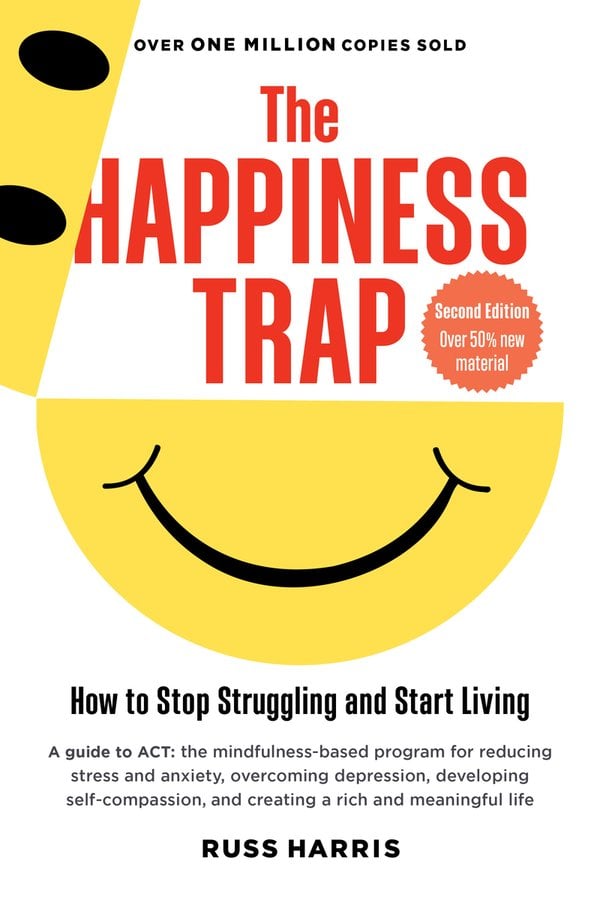
The Happiness Trap
By Russ Harris
Learn practical ACT-based strategies for handling difficult thoughts and emotions while building a more meaningful life.
Did you know? When you buy through Bookshop.org, you’re helping support independent bookstores.
Why Most People Stay Stuck
People don’t stay in their comfort zone because they don’t want to change.
They stay because:
- Change feels uncertain
- Uncertainty feels risky
- Risk feels uncomfortable
- Discomfort feels easier to avoid
Each layer builds on the one before it, making it feel easier to stay where you are, at least in the moment.
As a result, your brain naturally chooses the path of least resistance—not because it’s the best long-term option, but because it’s the most familiar.
Sometimes the hardest part of growth is understanding what’s actually holding you back. The Dig Deeper Journal with Prompts (available on Amazon) offers guided reflection questions designed to help you uncover recurring patterns and limiting beliefs.
The Principle Behind Lasting Change
The real key isn’t dramatic action or an overnight transformation.
It’s:
- Small actions
- Repeated consistently
- With gradually increasing levels of difficulty
This approach gradually expands your ability to handle discomfort over time.
And as that ability grows:
- More opportunities begin to feel within reach
- More actions start to feel natural
- More growth becomes possible
What once felt intimidating becomes something you can handle with confidence.
Final Thoughts
The comfort zone isn’t something you leave behind forever. It’s something you gradually expand over time.
It’s built on familiarity, reinforced by habits, shaped by your brain, and strengthened through repetition.
But it isn’t fixed.
Every small step you take outside your comfort zone gently pushes its boundaries outward. Over time, what once felt difficult begins to feel natural.
The goal isn’t to eliminate comfort altogether. It’s to expand your comfort zone until it includes the life you truly want to live.
Because real growth doesn’t come from one dramatic leap.
It comes from taking small, repeated steps into discomfort—until even discomfort starts to feel familiar.
*This article is for informational and educational purposes only and should not be considered a substitute for professional mental health advice. If you are experiencing emotional distress or mental health challenges, please seek guidance from a licensed therapist or mental health professional.

Linda is the co-founder of Courier Mind and holds a Diploma in Natural Health Nutrition & Diet. Her passions include photography, personal growth, and travel, where she draws inspiration from diverse cultures and their approaches to mindset and self-discovery. She is committed to helping others set meaningful goals, overcome self-doubt, and become the best version of themselves.