


Fixed Mindset vs Growth Mindset: Which One Is Running Your Life?
Have you ever looked at someone who seems naturally talented and thought, “I could never do that”?
Or made one mistake and immediately wondered if you were simply bad at something?
Maybe you’ve held back from applying for an opportunity because you weren’t sure you were qualified enough. Perhaps you’ve received criticism and spent the rest of the day defending yourself in your head.
Or you’ve watched someone else succeed and quietly taken their achievement as a sign that you don’t measure up.
Moments like these can reveal something important about how we think about our abilities. Do we believe our abilities are largely fixed—or do we believe they can develop over time?
That question sits at the heart of the fixed mindset vs growth mindset conversation.
It can be tempting to place ourselves neatly into one category, but the reality is more complicated. You might approach your career with a growth mindset while holding completely fixed beliefs about your creativity, intelligence, relationships, or confidence.
So which mindset is running your life?
The answer might depend on where you look.
This post contains affiliate links, which means we may earn a commission if you purchase through our links—at no extra cost to you. As an Amazon Associate we earn from qualifying purchases. We only recommend products we use or trust. Learn more about affiliate marketing or read our full disclosure.
What Is a Fixed Mindset?
A fixed mindset is the belief that qualities such as intelligence, talent, or ability are relatively set.
Found this helpful? Pin it for later so you can come back anytime.

When you think this way, being good at something can feel like proof that you have the ability. Struggling, on the other hand, may feel like proof that you don’t.
Imagine trying to learn a new language. You struggle to remember vocabulary, feel awkward when you speak, and notice another student progressing much faster.
A fixed-mindset response might be:
I’m just not good at languages.
That conclusion can feel perfectly logical because you’re treating your current performance as evidence of your underlying ability.
And once you decide you simply “aren’t good” at something, what motivation is there to keep going?
That’s where fixed-mindset thinking can shape your choices. It doesn’t always shout, “Give up!”
Sometimes it whispers:
- “That’s not really your thing.”
- “Don’t embarrass yourself.”
- “Other people are naturally better at this.”
- “Stick with what you know.”
The result can be the same: you stop before discovering how much you might have learned.
RELATED POST: The Growth Mindset Background: What Really Shapes Our Ability to Learn?
What Is a Growth Mindset?
A growth mindset takes a different view.
Instead of assuming your current ability reflects your permanent potential, you recognize that skills and abilities can develop through learning, practice, feedback, effective strategies, and experience.
So when that same language learner struggles, the response might become:
I’m finding this difficult. What could help me improve?
Notice what doesn’t happen.
- They don’t pretend the language is easy.
- They don’t automatically assume they’ll become fluent.
- And they don’t need to convince themselves that they’re secretly brilliant.
They simply leave room for development.
That creates a completely different next step. Instead of trying to prove whether you have an ability, you can start figuring out how to build it.
If you want to explore the idea of fixed and growth mindsets more deeply, Mindset by Carol S. Dweck (available on Bookshop.org) is the natural place to start. It takes a closer look at how the beliefs we hold about our abilities can shape the way we approach learning, challenges, and success.
book tip

Mindset: The New Psychology of Success
By Carol S. Dweck
Do you believe your abilities are fixed, or that you can grow with effort?
Did you know? When you buy through Bookshop.org, you’re helping support independent bookstores.
Fixed Mindset vs Growth Mindset: What’s the Real Difference?
The biggest difference isn’t whether you succeed or fail. It’s the meaning you give the experience.
Suppose two people receive the same critical feedback at work.
The first thinks:
My manager clearly doesn’t think I’m good enough.
The second thinks:
That was uncomfortable to hear. Is there something useful here that could make my work better?
Both may feel embarrassed. Both may dislike the feedback. But the way they interpret it sends them in different directions.
A fixed mindset often turns experiences into judgments about identity:
- “I failed, therefore I’m a failure.”
- “This is difficult, therefore I’m not talented.”
- “They’re better than me, therefore I don’t have what it takes.”
A growth mindset turns those same experiences into information:
- “I failed. Why?”
- “This is difficult. What do I need to learn?”
- “They’re better than me. What are they doing that I could study?”
One mindset asks, “What does this say about me?”
The other asks, “What can this teach me?”
RELATED POST: Growth Mindset Isn’t Just Positive Thinking: 7 Myths That Miss the Point
So how can you tell which mindset is running your life?
Let’s look at a few everyday situations where the difference tends to show up:
1. How Do You React When Something Gets Difficult?
Think about what happens when you’re not immediately good at something.
Do you become curious? Or embarrassed?
When things come easily, it can be hard to tell which mindset is operating. Challenge tends to reveal it.
You may happily say you love learning until learning requires you to feel confused for three weeks. You may believe mistakes are valuable until you make one in front of people you want to impress.
Pay attention to the moment difficulty shows up.
If your first thought is:
Maybe I’m not cut out for this,
fixed thinking may be taking over.
Found this helpful? Pin it for later so you can come back anytime.

A more growth-oriented question would be:
What part of this am I finding difficult?
Making the challenge specific gives you something you can actually work with.
If you want to get better at learning without expecting yourself to be good at everything straight away, The Art of Learning by Josh Waitzkin (available on Bookshop.org) is a fascinating read. It explores what it takes to keep learning, adapting, and improving when things become difficult.
book tip
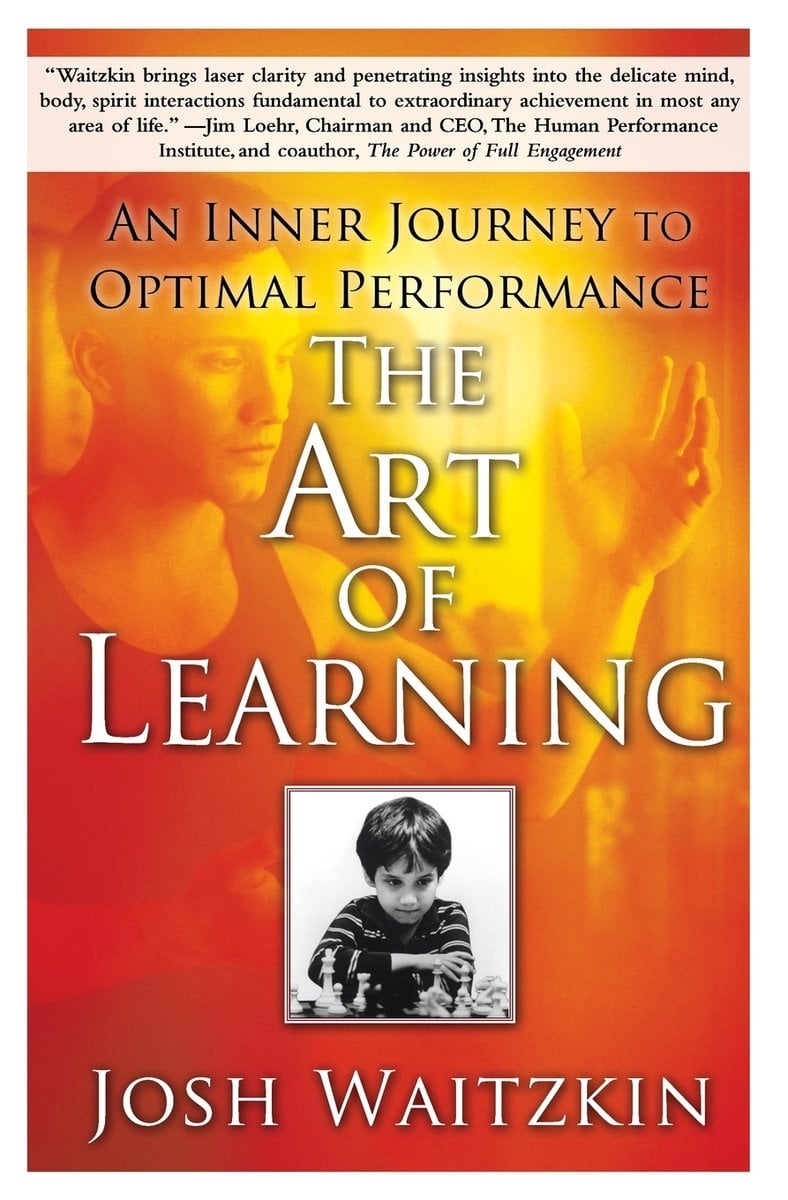
The Art of Learning
By Josh Waitzkin
This book explores how true mastery is built across any discipline. It reveals how performance, mindset, and learning strategies combine to create excellence.
Did you know? When you buy through Bookshop.org, you’re helping support independent bookstores.
2. What Does Failure Mean to You?
Failure is one of the clearest places to spot the difference between a fixed mindset and a growth mindset.
With a fixed mindset, failure can feel deeply personal. You didn’t simply fail at something. You feel like you are the failure.
That can make avoiding failure extremely appealing. If you don’t try, you can’t discover that you aren’t good enough.
But a growth mindset allows failure to become something else: feedback.
That doesn’t mean every failure is secretly wonderful. Some failures are painful. Some have real consequences. The question is whether the result becomes a final verdict or information you can use.
Instead of asking:
What does this failure prove about me?
try:
What does this experience show me that I didn’t know before?
That small shift can turn a dead end into a next step.
RELATED POST: How to Cultivate a Growth Mindset When You’re Afraid to Fail
3. How Do You Respond to Other People’s Success?
This one can be surprisingly revealing.
Imagine someone in your field achieves something you desperately want.
- What happens internally?
- Do you feel inspired?
- Or threatened?
If ability feels fixed, someone else’s success can seem like evidence that they have something you don’t.
- They’re talented. You’re not.
- They’re succeeding. You’re falling behind.
A growth mindset creates another possibility.
Instead of seeing successful people only as competition, you can also treat their success as information.
- What did they learn?
- What strategies did they use?
- How long have they been doing this?
- What mistakes did they make along the way?
You don’t have to eliminate jealousy entirely. You can simply get curious about it. Sometimes envy points directly toward something you want to develop.
RELATED POST: 10 Inspiring Growth Mindset Examples—and What They Can Teach Us
4. How Do You Respond to Criticism?
Few things activate fixed-mindset thinking faster than criticism.
Even helpful feedback can sound like: You’re not good enough.
- So we defend ourselves.
- Explain.
- Blame circumstances.
- Dismiss the person giving the feedback.
- Or avoid asking for feedback altogether.
A growth mindset doesn’t mean accepting every criticism as correct. Some feedback is inaccurate, poorly delivered, or simply unhelpful.
The skill is being able to ask:
Is there anything useful here?
You can disagree with part of someone’s criticism and still learn from another part. When you do that feedback stops being a judgment of your worth and becomes one possible source of information.
5. Do You Need to Look Naturally Good at Things?
Imagine you could choose between two tasks.
One is easy and lets you look highly capable. The other is difficult and gives you a much greater opportunity to learn—but there’s a good chance you’ll struggle.
Which do you choose?
- Fixed-mindset thinking often prefers opportunities that confirm ability.
- Growth-mindset thinking is more willing to enter situations where ability can develop.
This doesn’t mean constantly choosing the hardest possible option.
But if you always choose what makes you look competent, you may eventually stop putting yourself in situations where you can become more competent.
Sometimes growth requires being willing to look like a beginner.
If you’re curious about how people become exceptionally good at what they do, Peak by Anders Ericsson and Robert Pool (available on Bookshop.org) is well worth reading. It explores the science of expertise and shows why developing ability is often much more about how you practice than simply being “naturally talented.”
book tip

Peak
By Anders Ericsson and Robert Pool
This book challenges the idea of natural talent and shows how focused, structured practice can help anyone improve and perform at a higher level.
Did you know? When you buy through Bookshop.org, you’re helping support independent bookstores.
6. Listen for the Word “Just”
Fixed-mindset beliefs often hide inside ordinary sentences:
- “I’m just not creative.”
- “I’m just bad with money.”
- “I’m just not confident.”
- “I’m just terrible at public speaking.”
- “I’m just not a disciplined person.”
The word sounds harmless, but notice what it does. It turns a current difficulty into part of your identity.
Instead of saying:
I haven’t learned how to manage money effectively,
you become someone who is “bad with money.”
One description leaves room for change. The other closes the door.
The next time you hear yourself say, “I’m just…”, pause and ask:
Is this really who I am—or is it something I haven’t learned yet?
RELATED POST: 12 Simple Growth Mindset Tips to Change the Way You Think
7. You Probably Have Both Mindsets
Perhaps the most important thing to understand about fixed mindset vs growth mindset is that you don’t need to decide which “type of person” you are.
You probably experience both.
- You might confidently believe you can improve at work while thinking artistic ability is something people are simply born with.
- You may have a growth mindset about exercise but believe you’ll “never be good” at mathematics.
- You might welcome feedback from friends but become defensive when your partner criticizes you.
Rather than asking:
Do I have a growth mindset?
try asking:
Look for the situations where you feel threatened, defensive, embarrassed, jealous, or tempted to avoid a challenge.
Where does my mindset become fixed?
Those reactions aren’t proof that you’re doing growth mindset wrong. They’re clues.
Can You Change a Fixed Mindset?
The good news is that once you recognize fixed-mindset thinking, you have an opportunity to respond differently. You don’t need to eliminate every fixed thought. Start by catching one.
When you think: “I’m terrible at this,”
add: “right now.”
When you think: “I’ll never understand this,”
ask:“What haven’t I understood yet?”
When you think: “They’re naturally better than me,”
ask: “What could I learn from how they do it?”
And when something goes wrong, resist the urge to immediately turn the outcome into a statement about who you are.
Describe what happened first. Then decide what to do next. Over time, these small shifts can change the way you approach challenges.
RELATED POST: How to Develop a Growth Mindset When Giving Up Feels Easier
Final Thoughts
Fixed mindset vs growth mindset isn’t really about putting yourself into one box. It’s about noticing which beliefs show up when something matters to you.
When you struggle, do you assume you’ve reached the limit of your ability—or wonder what might help you improve?
When someone succeeds, do you see their achievement as proof that you’re falling behind—or as evidence of what might be possible?
When you receive criticism, do you hear a judgment—or look for useful information? And when you fail, do you turn one outcome into a definition of who you are?
You won’t always respond with a perfect growth mindset. You don’t need to. A more useful goal is simply to become aware of the moments when your thinking becomes fixed.
Because once you notice the thought—
I’m just not good at this.
—you have an opportunity to question it.
- Maybe you’re not good at it yet.
- Maybe you need a different strategy.
- Maybe you need help.
- Maybe you need more practice.
- Or perhaps you simply need to give yourself permission to be a beginner.
So, which mindset is running your life?
The answer may change from one situation to another. But the next time a fixed belief appears, you get to decide whether you want to let it have the final word.
*This article is for informational and educational purposes only and should not be considered a substitute for professional mental health advice. If you are experiencing emotional distress or mental health challenges, please seek guidance from a licensed therapist or mental health professional.
Diener, C. I., and Carol S. Dweck. “An Analysis of Learned Helplessness: Continuous Changes in Performance, Strategy, and Achievement Cognitions Following Failure.” Journal of Personality and Social Psychology, vol. 36, no. 5, 1978, pp. 451–62. https://doi.org/10.1037/0022-3514.36.5.451. Abstract only.
Elliott, E S, and C S Dweck. “Goals: an approach to motivation and achievement.” Journal of personality and social psychology vol. 54,1 (1988): 5-12. doi:10.1037//0022-3514.54.1.5. Abstract only.
Gál, Éva et al. “Fixed Intelligence Mindset, Self-Esteem, and Failure-Related Negative Emotions: A Cross-Cultural Mediation Model.” Frontiers in psychology vol. 13 852638. 20 May. 2022, doi:10.3389/fpsyg.2022.852638. Adapted and used under the terms of the Creative Commons Attribution 4.0 International License.
Haimovitz, Kyla, and Carol S Dweck. “Parents’ Views of Failure Predict Children’s Fixed and Growth Intelligence Mind-Sets.” Psychological science vol. 27,6 (2016): 859-69. doi:10.1177/0956797616639727. Abstract only.

Linda is the co-founder of Courier Mind and holds a Diploma in Natural Health Nutrition & Diet. Her passions include photography, personal growth, and travel, where she draws inspiration from diverse cultures and their approaches to mindset and self-discovery. She is committed to helping others set meaningful goals, overcome self-doubt, and become the best version of themselves.