


Why Most People Never Leave Their Comfort Zone
Have you ever caught yourself dreaming about a different life—starting a business, traveling the world, changing careers or learning a new skill —only to end up doing… nothing?
If so, you’re far from alone.
The truth is that most people never leave their comfort zone. It’s not because they’re lazy or incapable. It’s because the human brain is wired to seek safety, familiarity, and predictability.
Staying where things feel comfortable can provide a sense of security in the short term, but it often comes at the expense of growth, fulfillment, and new opportunities.
Your comfort zone isn’t a physical place. It’s a mental space where everything feels familiar, predictable, and within your control.
There’s very little risk there—but there’s also very little transformation. Nearly every meaningful achievement, whether personal or professional, begins just beyond that invisible boundary.
In this article, we’ll explore why so many people stay stuck, what holds them back from growing, and how you can begin taking small, meaningful steps to leave your comfort zone and build a bigger, more rewarding life.
This post contains affiliate links, which means we may earn a commission if you purchase through our links—at no extra cost to you. As an Amazon Associate we earn from qualifying purchases. We only recommend products we use or trust. Learn more about affiliate marketing or read our full disclosure.
What Is a Comfort Zone?
A comfort zone is a psychological state where your routines, habits, and behaviors feel safe and predictable. You know what to expect, so your stress levels stay relatively low.
Found this helpful? Pin it for later so you can come back anytime.

There’s nothing inherently wrong with having a comfort zone. Everyone needs stability and time to rest.
The problem begins when comfort becomes permanent and starts holding you back from personal growth.
Imagine a bird that never leaves its nest. The nest offers warmth and safety, but it isn’t where the bird is meant to spend its entire life.
Eventually, it has to take the risk of flying to discover what it’s truly capable of.
The same is true for us. Growth requires movement, and movement almost always involves uncertainty.
RELATED POST: The Ultimate Guide to the Comfort Zone: What It Is and How to Break Free
Fear Is the Biggest Barrier
Fear is the number one reason most people never leave their comfort zone.
This fear takes many forms:
- Fear of failure
- Fear of rejection
- Fear of embarrassment
- Fear of criticism
- Fear of making the wrong decision
- Fear of losing security
Ironically, most of these fears exist only in our imagination.
Our brains are incredibly good at predicting worst-case scenarios because, from an evolutionary standpoint, avoiding danger helped our ancestors survive.
Today, though, our biggest threats usually aren’t wild animals. They’re uncomfortable conversations, career changes, public speaking, or trying something new.
The brain often responds to these situations as if they’re life-threatening, even when they aren’t.
Recognizing this natural instinct is the first step toward overcoming it.
If you tend to avoid situations that feel uncomfortable or uncertain, The Happiness Trap by Russ Harris (available on Amazon) offers practical tools for handling difficult thoughts and emotions without letting them dictate your decisions.
RELATED POST: Why Getting Out of Your Comfort Zone Feels So Hard
Familiarity Feels Safe
As humans, we naturally gravitate toward what’s familiar. Even when a situation isn’t ideal, we often stay because we know what to expect.
- Someone may remain in a job they dislike for years simply because it’s predictable.
- Another person may stay in an unhealthy relationship because they’re afraid of being alone.
- Others put their dreams on hold because routine feels easier than uncertainty.
Familiarity creates the illusion of safety. But familiar doesn’t always mean fulfilling.
Many people mistake comfort for happiness when they’re actually settling for predictability.
Why We Avoid Failure
From an early age, many people are taught that failure is something to fear.
- Good grades are rewarded.
- Mistakes are corrected.
- Success is celebrated.
- Failure is often criticized.
As adults, that mindset often stays with us.
People avoid taking risks because they don’t want to fail in front of others. Yet every successful entrepreneur, athlete, artist, inventor, and leader has experienced countless failures along the way.
Failure isn’t the opposite of success. It’s part of the journey.
Every setback teaches valuable lessons that simply can’t be learned by staying comfortable.
The people who achieve extraordinary things aren’t fearless—they’ve just decided not to let fear make their decisions.
The Comfort Zone Creates the Illusion of Progress
Being busy doesn’t always mean you’re moving forward.
Many people spend years planning instead of acting.
- They read books.
- Watch motivational videos.
- Listen to podcasts.
- Create endless to-do lists.
- Research every possible outcome.
Preparation has value, but eventually it can turn into procrastination disguised as productivity. Real growth comes through action.
No amount of planning can replace real-world experience.
Society Often Rewards Playing It Safe
Society often encourages stability.
People are praised for following predictable paths:
- Graduate.
- Get a secure job.
- Work steadily.
- Avoid unnecessary risks.
- Retire someday.
While there’s nothing wrong with this path, it isn’t the only one.
Many people suppress their passions because they worry about what others might think. The fear of being judged becomes stronger than the desire to grow.
Ironically, those same people often admire individuals who had the courage to take risks. The difference is that successful people chose to act despite the uncertainty.
Found this helpful? Pin it for later so you can come back anytime.
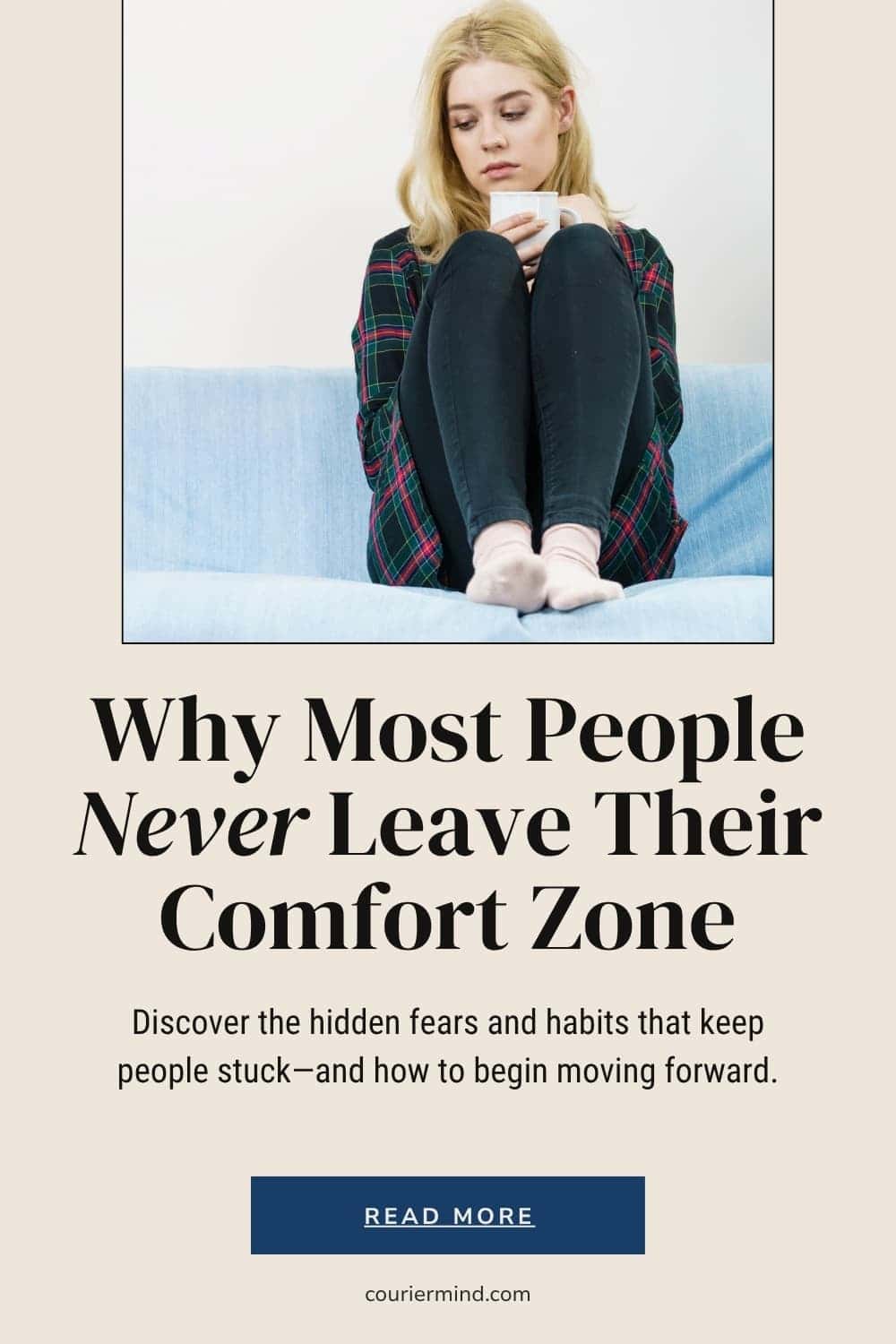
Confidence Comes After Action
One of the biggest misconceptions is that confidence comes first.
People often think:
- “I’ll apply once I’m confident.”
- “I’ll start my business when I feel ready.”
- “I’ll speak up once I stop being nervous.”
Unfortunately, confidence doesn’t work that way. It’s built through experience.
Every small success strengthens your belief in yourself. Every challenge you overcome reminds you that you’re capable of handling difficult situations.
Waiting to feel confident before taking action usually means waiting forever.
Action creates confidence—not the other way around.
Comfort Can Become a Habit
The longer people stay inside their comfort zone, the harder it becomes to leave.
Comfort becomes routine. Routine becomes identity.
Eventually, people begin telling themselves:
- “This is just who I am.”
- “I’ve always been shy.”
- “I’m not a risk-taker.”
- “I’m too old.”
- “I’m not talented enough.”
Over time, these beliefs become self-fulfilling.
In reality, they’re often just stories you’ve repeated so many times that they begin to feel like facts.
Your identity isn’t fixed. It evolves through the choices you make every day.
If you’ve ever felt limited by labels like “I’m not that kind of person,” Mindset by Carol S. Dweck (available on Bookshop.org) offers an interesting perspective on how beliefs about your abilities can shape what you believe is possible.
book tip

Mindset: The New Psychology of Success
By Carol S. Dweck
Do you believe your abilities are fixed, or that you can grow with effort?
Did you know? When you buy through Bookshop.org, you’re helping support independent bookstores.
RELATED POST: 7 Signs You’re Stuck in Your Comfort Zone Without Realizing It
Growth Is Usually Uncomfortable
Every meaningful life change comes with some level of discomfort.
- Learning a language feels awkward.
- Starting a fitness routine is exhausting.
- Launching a business is uncertain.
- Moving to a new city is intimidating.
- Making new friends requires vulnerability.
None of these experiences feel comfortable at first. But discomfort is often a sign that growth is taking place.
Think about the last time you learned something difficult. It probably felt frustrating at the beginning.
Eventually, what once seemed impossible became second nature.
That’s how growth works. Today’s discomfort becomes tomorrow’s confidence.
RELATED POST: What Really Happens When You Step Out of Comfort Zone
Small Steps Matter More Than Giant Leaps
Leaving your comfort zone doesn’t require dramatic life changes overnight.
In fact, small, consistent actions are often far more effective.
You might:
- Speak up during one meeting.
- Introduce yourself to someone new.
- Learn a skill for fifteen minutes each day.
- Apply for one opportunity.
- Start a side project.
- Say yes to an invitation you would normally decline.
These small actions gradually expand your comfort zone. What once felt intimidating slowly becomes familiar.
Progress compounds over time.
The Cost of Staying Comfortable
Most people focus on the risks of taking action. Far fewer think about the risks of staying exactly where they are.
Ask yourself:
- What opportunities am I missing?
- What dreams am I postponing?
- What relationships could I build?
- What skills could I develop?
- Who could I become?
The years pass more quickly than most of us expect. For many people, the greatest regret isn’t failure—it’s never trying.
The pain of regret often lasts much longer than the discomfort of taking a chance.
RELATED POST: Your Comfort Zone Will Kill You—But Most People Never Realize It
If you’re trying to make lasting changes but keep falling back into old routines, Atomic Habits by James Clear (available on Bookshop.org) offers a practical framework for building better habits through small, consistent actions.
book tip

Atomic Habits
By James Clear
Want to change your life without relying on willpower?
Did you know? When you buy through Bookshop.org, you’re helping support independent bookstores.
Successful People Feel Fear Too
It’s easy to assume successful people are naturally fearless. They’re not.
- Authors worry before publishing books.
- Entrepreneurs fear launching products.
- Athletes feel nervous before competitions.
- Public speakers still experience anxiety.
The difference is simple.
Successful people understand that courage isn’t the absence of fear. It’s the willingness to act despite it.
Fear never disappears completely. You simply become stronger than it.
How to Start Expanding Your Comfort Zone
If you’re ready to grow, start with manageable challenges rather than overwhelming goals. Begin by identifying one thing you’ve been avoiding because it feels uncomfortable.
Then ask yourself:
What’s the smallest possible step I could take today?
Instead of focusing on the entire journey, focus on the very next step.
- Celebrate progress instead of perfection.
- Accept mistakes as part of the learning process.
- Limit comparisons with others because everyone’s journey unfolds differently.
- Most importantly, remember that growth is a lifelong process, not a destination.
Every time you challenge yourself, your comfort zone expands a little further.
The Life Beyond Your Comfort Zone
Imagine looking back years from now. Would you rather remember the risks you took—or the opportunities you never pursued?
The most memorable moments in life rarely happen while you’re staying comfortable.
- They happen when you travel somewhere unfamiliar.
- When you begin a new career.
- When you learn something difficult.
- When you fall in love.
- When you create something meaningful.
- When you finally decide that fear will no longer make your decisions.
Life begins to expand the moment your comfort zone does.
Final Thoughts
Most people never leave their comfort zone because the unknown feels intimidating. Our brains crave familiarity, our fears exaggerate potential risks, and society often encourages us to play it safe.
Yet staying comfortable for too long can limit your potential and leave you wondering what might have been.
Growth doesn’t require fearless leaps or overnight transformation. It begins with one small decision to try something different, embrace uncertainty, and accept that discomfort is a natural part of progress.
Every conversation you start, every challenge you accept, and every risk you take builds resilience and confidence that simply can’t be developed by standing still.
Remember, your comfort zone isn’t your destination—it’s your starting point. The life you dream about is built one courageous step at a time.
You don’t have to be fearless to move forward. You simply have to be willing to take that first step, even when it feels uncomfortable.
That’s where real change begins—and where your greatest opportunities are waiting.
*This article is for informational and educational purposes only and should not be considered a substitute for professional mental health advice. If you are experiencing emotional distress or mental health challenges, please seek guidance from a licensed therapist or mental health professional.
"Dopamine." Cleveland Clinic, last reviewed 23 March 2022, https://my.clevelandclinic.org/health/articles/22581-dopamine. Accessed 5 October 2024.
Gardner, B., Rebar, A. L., and Lally, P. "How does habit form? Guidelines for tracking real-world habit formation." Cogent Psychology, 9(1), 2022, https://doi.org/10.1080/23311908.2022.2041277. Adapted and used under the terms of the Creative Commons Attribution 4.0 International License.
Hannah, David R, and Kirsten Robertson. “Emotional regulation in veterinary work: Do you know your comfort zone?.” The Canadian veterinary journal = La revue veterinaire canadienne vol. 61,2 (2020): 178-180, https://www.ncbi.nlm.nih.gov/pmc/articles/PMC6973202/.
Henderson, Rob. "How Powerful Is Status Quo?" Psychology Today, 29 September 2016, https://www.psychologytoday.com/us/blog/after-service/201609/how-powerful-is-status-quo-bias. Accessed 5 October 2024.
Heshmat, Shahram, Ph.D. "What is Confirmation Bias?" Psychology Today, 23 April 2015, https://www.psychologytoday.com/us/blog/science-of-choice/201504/what-is-confirmation-bias. Accessed 5 October 2024.
Kawamura, K.Y. "Body Image among Asian Americans." Encyclopedia of Body Image and Human Appearance, Academic Press, 2012, Pages 95-102, ISBN 9780123849250, https://doi.org/10.1016/B978-0-12-384925-0.00039-0.
Kent, Jessica A. "Is It Time to Leave Your Comfort Zone? How Leaving Can Spark Positive Change." Harvard Summer School, updated 28 August 2023, https://summer.harvard.edu/blog/leaving-your-comfort-zone/. Accessed 5 October 2024.
Mbiydzenyuy, N.E. and Qulu, LA. "Stress, hypothalamic-pituitary-adrenal axis, hypothalamic-pituitary-gonadal axis, and aggression." Metab Brain Dis (2024), https://doi.org/10.1007/s11011-024-01393-w. Adapted and used under the terms of the Creative Commons Attribution 4.0 International License.
Shanley, Ellen R. "Become Comfortable with the Uncomfortable: The Rewards of Leaving Our Comfort Zone." Journal of the Academy of Nutrition and Dietetics, Volume 122, Issue 10, 1815 - 1816, https://www.jandonline.org/article/S2212-2672(22)00727-4/fulltext.
Van Gelderen, Marco. “Using a comfort zone model and daily life situations to develop entrepreneurial competencies and an entrepreneurial mindset.” Frontiers in psychology vol. 14 1136707. 15 May. 2023, doi:10.3389/fpsyg.2023.1136707. Adapted and used under the terms of the Creative Commons Attribution 4.0 International License.

Linda is the co-founder of Courier Mind and holds a Diploma in Natural Health Nutrition & Diet. Her passions include photography, personal growth, and travel, where she draws inspiration from diverse cultures and their approaches to mindset and self-discovery. She is committed to helping others set meaningful goals, overcome self-doubt, and become the best version of themselves.