

7 Signs You’re Stuck in a Mediocre Mindset and How to Change It
Most people don’t wake up one morning and think:
I want to play it small, avoid growth, and settle for less.
And yet, many of us gradually fall into habits and thought patterns that hold us back without even realizing it.
That’s how a mediocre mindset develops.
A mediocre mindset is dangerous because it rarely feels obvious. Most of the time, it simply feels normal.
It can show up in subtle ways:
- Procrastinating on meaningful goals
- Avoiding discomfort
- Constantly doubting yourself
- Settling into routines that no longer challenge you
- Believing growth is unrealistic for “people like you”
Over time, these patterns can begin shaping everything from your decisions and habits to your confidence, identity, and the direction of your life.
The good news is that a mediocre mindset isn’t permanent. It’s learned—and anything that’s learned can be changed.
In this guide, you’ll learn how to recognize the signs of a mediocre mindset, understand why it develops, and discover practical ways to build a healthier, more growth-oriented way of thinking.
This post contains affiliate links, which means we may earn a commission if you purchase through our links—at no extra cost to you. As an Amazon Associate we earn from qualifying purchases. We only recommend products we use or trust. Learn more about affiliate marketing or read our full disclosure.
What Is a Mediocre Mindset?
A mediocre mindset isn’t about being unintelligent, lacking talent, or not being successful.
Found this helpful? Pin it for later so you can come back anytime.

Instead, it’s a way of thinking where:
- Comfort becomes more important than growth
- Fear often outweighs action
- Much of your potential remains untapped
- Your personal limits start to feel permanent and impossible to change
People with a mediocre mindset often:
- Undervalue themselves
- Avoid challenges that could help them grow
- Stay within the same familiar routines
- Stop believing that meaningful progress or change is possible
But the real problem isn’t a lack of ability. It’s the slow and often unnoticed way that stagnation starts to feel normal.
Over time, staying comfortable can feel safer than growing, and settling can begin to seem reasonable rather than temporary.
And that’s how a mediocre mindset slowly takes root.
RELATED POST: Am I Mediocre? The Truth Most People Don’t Want to Face
Why a Mediocre Mindset Develops
No one is born with a mediocre mindset. It develops gradually over time through repeated experiences, habits, and emotional patterns.
In most cases, it doesn’t come from a single dramatic event.
Instead, it grows from many small moments, disappointments, fears, and coping behaviors that slowly shape how you see yourself and what you believe you’re capable of achieving.
Common causes include:
- Fear of failure
- Repeated disappointment
- Social conditioning
- Comfort addiction
- Constant comparison
- Low confidence
- Emotionally draining environments
Over time, your brain begins to adjust to smaller expectations because those expectations feel emotionally safer and easier to manage.
Without even realizing it, people start telling themselves:
If I don’t expect too much from myself, I can’t really fail.
At first, this can feel like a way to protect yourself. But over time, that protection becomes a limitation.
Instead of helping you move forward, it keeps you stuck in familiar patterns, smaller goals, and a version of life that feels safe—but ultimately leaves you unfulfilled.
RELATED POST: Should You Accept Mediocrity to Be Happier? A Deep Look
The Hidden Dangers of a Mediocre Mindset
The danger of a mediocre mindset isn’t sudden failure.
The real risk is slowly becoming smaller than what you’re capable of. It happens bit by bit, often so gradually that you barely notice it happening at all.

Over time, people start to:
- Stop pushing themselves
- Lower their personal standards
- Avoid opportunities that feel uncertain or uncomfortable
- Become reactive instead of proactive
- Stop believing that real change is possible for them
Little by little, ambition is replaced by routine, and growth gives way to simply maintaining the status quo.
And because this shift happens so slowly, it can begin to feel completely normal. That’s what makes a mediocre mindset so difficult to recognize.
It rarely feels dramatic or obvious that something is wrong.
Most of the time, it simply feels “comfortable enough.”
- Comfortable enough to stay where you are.
- Comfortable enough to delay growth.
- Comfortable enough to avoid change.
And that’s exactly why these patterns often stay in place for so long.
RELATED POST: Why Mediocre Relationships Feel “Fine” But Still Hurt You
7 Signs You May Have a Mediocre Mindset
Let’s take a look at some common signs of a mediocre mindset.
These signs are often subtle, which is why many people go years without noticing them, even though they quietly influence their growth and progress.
1. You Constantly Wait Until You Feel Ready
People with a growth-oriented mindset understand an important truth:
Readiness usually comes after you take action, not before.
Confidence is typically built through experience, repetition, and stepping outside your comfort zone—not by waiting for the perfect moment.
People with a mediocre mindset, however, often think:
I’ll start when I feel confident.
As a result, they often:
- Overthink every decision
- Spend more time preparing than actually starting
- Research endlessly without taking action
- Delay anything that feels uncomfortable or uncertain
On the surface, this can look productive. In reality, though, it often becomes stagnation disguised as preparation.
The longer someone waits to “feel ready,” the easier it becomes to remain stuck exactly where they are.

2. You Avoid Discomfort Whenever Possible
Real growth almost always involves some level of discomfort.
That discomfort can show up as:
- Uncertainty
- Mistakes
- Awkward moments
- Rejection
- Emotional risk
None of these experiences feel pleasant, but they’re often part of genuine, meaningful progress. The problem is that a mediocre mindset tends to prioritize emotional comfort over long-term growth.
As a result, many people continue choosing what feels familiar and comfortable in the moment, even when it limits their future potential.
This often shows up as choosing:
- Familiar routines instead of new challenges
- Low-risk situations over meaningful opportunities
- Short-term comfort over long-term improvement
The problem is that comfort can become addictive. The more someone avoids discomfort, the more uncomfortable discomfort begins to feel.
And over time, even small risks can start to feel overwhelming, causing growth to be delayed far longer than it needs to be.
3. You Compare Yourself Constantly
Comparison can drain your motivation and distort the way you view your own progress.
Instead of focusing on their own journey, people with a mediocre mindset often become fixated on:
- Who is ahead
- Who is more successful
- Who appears more talented or capable
Over time, this habit doesn’t just lead to discouragement—it gradually begins to shape how you see yourself.
Progress can start to feel meaningless because there will always be someone who seems to be “doing better.”
This often leads to a familiar thought pattern:
I’ll never be good enough anyway.
And once that belief takes hold, it can create a kind of emotional paralysis where putting in effort starts to feel pointless, even though real improvement is still completely possible.
4. You Start Things but Rarely Finish Them
This is incredibly common.
People often start with motivation and good intentions, but once the initial excitement wears off, things tend to unravel:
- Projects get abandoned
- Routines gradually fade away
- Goals get left behind
What begins as momentum slowly turns into a collection of unfinished efforts.
Over time, this pattern doesn’t just affect what you accomplish—it also changes how you see yourself. Each unfinished attempt can slightly weaken your self-trust, even if you don’t notice it happening right away.
Eventually, people may begin to see themselves as:
- Inconsistent
- Undisciplined
- Unable to follow through
And once that identity starts to take shape, it becomes even harder to start again or fully commit in the future.
5. You Secretly Believe Growth Is for “Other People”
This is one of the deeper and more subtle signs of a mediocre mindset.
On the surface, people may admire successful, disciplined, or highly motivated individuals. They may even respect their habits and accomplishments.
But underneath, a quiet belief can begin to form:
That’s just not me.
This creates an invisible identity barrier that influences behavior far more than most people realize.
Because whether people are aware of it or not, they rarely act beyond what they believe is genuinely possible for themselves.
So even when opportunities are right in front of them, putting in effort can feel out of alignment, and long-term growth can seem like something that’s “meant for other people,” not something they can fully step into themselves.
And over time, this belief doesn’t just limit their actions—it also limits what they even consider worth trying in the first place.
6. You Mistake Busyness for Progress
A mediocre mindset often hides behind constant activity. On the surface, it can seem like things are moving forward.
People stay:
- Busy
- Distracted
- Overloaded
There’s always something to do, somewhere to be, or something that needs a response. But beneath all that activity, real progress can still be minimal.
The key problem is that movement can feel productive, even when it isn’t actually moving you toward anything meaningful. And over time, busyness begins to replace clarity.
Instead of asking, “Am I actually improving?” it becomes easier to focus on simply staying busy.
But movement without direction doesn’t create real change—it only creates the illusion of progress without the results.
7. You Stay in Environments That Keep You Small
Your environment influences your mindset far more than most people realize.
The people you spend time with, the conversations you regularly have, and the overall atmosphere around you all gradually shape what starts to feel normal.
If you’re constantly surrounded by:
- Negativity
- Passivity
- Low standards
- Fear-based thinking
your mindset will slowly begin to absorb those same patterns.
Not because you consciously choose them, but because repeated exposure makes them feel normal.
It’s a simple way to begin building a more supportive inner dialogue, especially if your external environment hasn’t provided much encouragement.
And over time, what once felt limiting can begin to feel completely normal.
We tend to mirror our environments more than we realize. The expectations, attitudes, and behaviors around us gradually shape what we believe is possible—and what we eventually stop reaching for.
A lot of people don’t realize how much their inner voice is shaped by their environment. The Switch Research Self-Talk Journal (available on Amazon) can help you become more aware of those thought patterns and start replacing unhelpful beliefs with more supportive ones over time.
RELATED POST: Why Most People Never Escape Mediocrity (Even When They Try)
Why Mediocre Mindsets Feel Comfortable
This is an important point to understand:
A mediocre mindset often feels comfortable because, at its core, it serves as a form of emotional protection.
It creates a buffer against experiences that can feel threatening or painful, such as:
- Failure
- Embarrassment
- Disappointment
- Uncertainty
When expectations remain low, the emotional risk tends to feel lower as well. There’s less at stake, less pressure, and fewer opportunities for things to go wrong in a significant way.
So a mediocre mindset isn’t always driven by laziness or a lack of ambition. In many cases, it’s actually a form of self-protection.
It’s a way of reducing emotional exposure and avoiding situations that could lead to discomfort or pain.
But the problem begins when that protection turns into a limitation—when the strategies designed to keep you safe start holding back your growth, potential, and long-term direction in life.
Much of personal growth involves learning to move forward even when discomfort is present. The Happiness Trap by Russ Harris (available on Bookshop.org) explores practical ways to do exactly that.
book tip
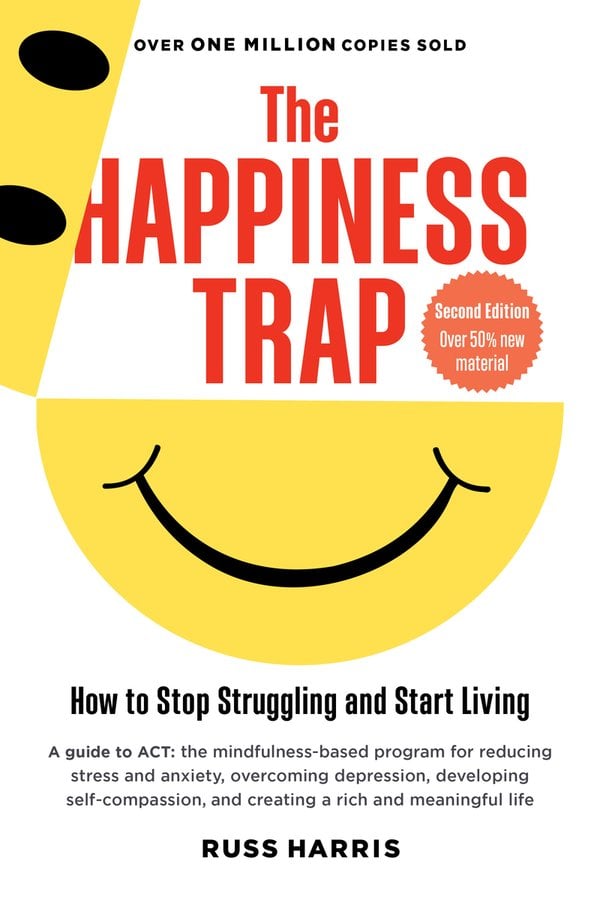
The Happiness Trap
By Russ Harris
Learn practical ACT-based strategies for handling difficult thoughts and emotions while building a more meaningful life.
Did you know? When you buy through Bookshop.org, you’re helping support independent bookstores.
Found this helpful? Pin it for later so you can come back anytime.

How to Change a Mediocre Mindset
Now let’s focus on making a change.
1. Become Aware of Your Automatic Thoughts
Most limiting beliefs don’t show up as loud or obvious statements. Instead, they tend to operate in the background, quietly influencing your decisions without you fully noticing.
Start by paying attention to recurring thoughts such as:
- “I’m not disciplined.”
- “People like me don’t succeed.”
- “I’ll probably fail anyway.”
- “It’s too late for me.”
These types of thoughts often feel automatic and convincing in the moment, which is exactly what makes them so powerful. Over time, they can influence your behavior far more than you realize.
This is why awareness is so important.
Because before anything can change, you first need to recognize what’s actually operating in the background.’
Cognitive behavioral therapy (CBT), developed by Aaron T. Beck, is based on the idea that thoughts, feelings, and behaviors are interconnected. When you learn to identify and evaluate negative automatic thoughts, it can become easier to change unhelpful thinking patterns and behaviors.
For a deeper understanding of how beliefs shape behavior, Mindset by Carol S. Dweck (available on Bookshop.org) explores the difference between fixed and growth-oriented thinking.
book tip

Mindset: The New Psychology of Success
By Carol S. Dweck
Do you believe your abilities are fixed, or that you can grow with effort?
Did you know? When you buy through Bookshop.org, you’re helping support independent bookstores.
2. Stop Waiting for Confidence
Confidence is often misunderstood.
Many people assume the process works like this:
Action follows confidence
But in reality, it usually works the opposite way:
Confidence follows repeated action
People rarely become confident before they take action. Instead, they become confident because they act, even when they feel uncertain.
Confidence is built through experience—by:
- Practicing consistently
- Making mistakes and learning from them
- Building evidence through repetition over time
Every attempt, even the imperfect ones, adds to that internal proof that “I can handle this.”
According to psychologist Albert Bandura’s research on self-efficacy, confidence develops through experiences that demonstrate a person’s ability to succeed. When you successfully perform tasks and overcome challenges, your confidence grows.
When someone waits for confidence before they begin, it often creates a cycle of delay. The feeling they’re waiting for rarely appears on its own because confidence is developed through action, not something that exists beforehand.
In that sense, waiting becomes the very thing that prevents confidence from ever developing.

3. Start Building Small Wins
Big change can feel overwhelming at first. When goals seem too large, too distant, or too emotionally demanding, it becomes much easier to put them off or avoid them altogether.
That’s why small wins matter so much.
They’re powerful because they:
- Build momentum
- Increase self-trust
- Reinforce new identity patterns
Instead of trying to change everything at once, progress becomes more achievable and sustainable through small, repeatable actions.
Research indicate that habits are formed through repeated behaviors performed in consistent contexts. Repetition gradually increases automaticity, making desired behaviors easier to maintain over time.
For example:
- Exercising for just 10 minutes
- Finishing one small task you’ve been putting off
- Reading consistently, even in short sessions
- Following through on simple daily commitments
On their own, these actions may seem small. But over time, repeated wins begin to compound and build on one another.
And gradually, they don’t just change your behavior—they start to reshape your identity.
4. Learn to Tolerate Discomfort
This is one of the most important mindset shifts you can make. Discomfort is not automatically a sign that something is wrong.
More often, it simply means:
- You are growing
- You are doing something unfamiliar
- You are expanding your limits
Research on anxiety and avoidance suggests that avoidance behaviors can maintain fear and contribute to the persistence of anxiety over time. Experts explain that avoiding feared situations may reduce opportunities to learn new ways of responding and coping.
People with a growth-oriented mindset don’t avoid discomfort—they expect it. They see it as a normal part of progress rather than a signal to stop.
People with a mediocre mindset, on the other hand, often interpret discomfort as danger. If something feels uncertain, awkward, or emotionally challenging, the natural response is usually to pull back or stay within safer limits.
That difference changes everything.
Because once you begin to see discomfort as part of growth rather than a threat, it becomes much easier to stay consistent, take action, and move through situations that would have previously led to avoidance.
5. Change Your Environment
A mediocre mindset is strongly influenced by your environment.
The way you think is constantly being shaped by what surrounds you—often without you even realizing it.
That’s why it helps to intentionally improve:
- What you consume online
- Who you spend time with
- Your daily routines
- Your physical environment
If your environment keeps pulling you back into old habits, it’s usually not a motivation problem—it’s a structure problem.
A tool like the Legend Planner PRO (available on Amazon) can help create more structure around your goals, habits, and daily priorities so it’s easier to stay consistent over time.
Even small changes in your environment can have a meaningful impact over time on:
- Focus
- Motivation
- Personal standards
- Emotional energy
Because when your environment changes, your default behaviors gradually begin to change as well.
If you’re struggling to break old patterns, Atomic Habits by James Clear (available on Bookshop.org) offers practical strategies for changing your environment and building behaviors that support long-term growth.
book tip

Atomic Habits
By James Clear
Want to change your life without relying on willpower?
Did you know? When you buy through Bookshop.org, you’re helping support independent bookstores.
6. Stop Defining Yourself by Your Past
Many people stay stuck not because they can’t change, but because they become overly attached to who they used to be.
They begin telling themselves:
- “I’ve always been this way.”
- “I never follow through.”
- “I’m just not disciplined.”
Over time, these statements stop feeling like observations and start feeling like identity.
Studies suggest that self-compassion is associated with greater emotional resilience and persistence after setbacks. Treating yourself with kindness following mistakes or failures may help you stay motivated and continue pursuing your goals more effectively than harsh self-judgment.
Remember, past behavior is not permanent identity. It’s simply evidence of what happened before—not a prediction of what must happen next.
What you’ve done in the past may explain certain patterns, but it doesn’t lock you into them forever.
Growth begins when you stop treating your past as a fixed label and start creating room for change—room to act differently, choose differently, and gradually become someone new through consistent action.
If you often feel trapped by old patterns, The Mountain Is You by Brianna Wiest (available on Amazon) offers a thoughtful look at self-sabotage and personal transformation.
7. Focus More on Consistency Than Intensity
A common mistake is trying to change everything through short bursts of extreme effort.
At first, intensity can feel exciting and motivating. It creates the impression that major change is happening quickly. But the problem is that intensity rarely lasts.
Consistency, on the other hand, is what creates lasting transformation because it gradually reshapes:
- Habits
- Identity
- Emotional resilience
- Long-term behavior patterns
Research suggests that lasting behavior change is supported by consistent actions repeated over time. Repetition gradually increases automaticity, making desired behaviors easier to maintain and less reliant on moment-to-moment motivation.
A mediocre mindset often depends on bursts of motivation—waiting for the “right mood” or a sudden surge of inspiration before taking action.
A growth-oriented mindset takes a different approach. It focuses less on how intense the effort feels in the moment and more on whether that effort can be sustained over time.
Because real change isn’t built through bursts of effort—it’s built through steady repetition that compounds over time.
8. Develop Long-Term Thinking
A mediocre mindset often focuses heavily on immediate comfort and short-term relief. It prioritizes what feels easiest right now, even when it doesn’t support future growth.
A growth-oriented mindset, however, asks a different question:
What will this choice create over time?
This shift in perspective changes the way decisions are made, especially during moments of discomfort or temptation.
Because small, repeated choices don’t remain small—they compound over time into:
- Habits
- Confidence
- Skills
- Opportunities
Long-term thinking also makes it easier to tolerate short-term discomfort because your focus isn’t only on how something feels right now, but also on what it contributes to in the future.
And that broader perspective often makes it easier to stay consistent, even when progress feels slow.

9. Accept That Progress Will Feel Slow
One of the main reasons people fall back into a mediocre mindset is because they have unrealistic expectations about how change should feel.
Many people expect:
- Rapid transformation
- Instant confidence
- Immediate, visible success
But meaningful growth rarely feels that way in the beginning.
In reality, the early stages of change are often:
- Repetitive
- Uncertain
- Emotionally uncomfortable
And because the process doesn’t feel exciting or dramatic, it can easily discourage people from continuing.
This is where many people stop—not because progress isn’t happening, but because it doesn’t feel like progress yet.
However, those who continue through this slower phase eventually build momentum that many others never reach.
Because once consistency starts to compound over time, what once felt slow and difficult begins to turn into noticeable, lasting change.
RELATED POST: How to Overcome Mediocrity and Finally Stand Out in Life
What a Healthy Growth Mindset Looks Like
A healthy growth mindset is often misunderstood. It’s not about forcing yourself to stay positive, chasing perfection, or constantly pushing yourself to the point of exhaustion.
It is also not:
- Toxic positivity
- Perfectionism
- Endless hustle
- Constant self-criticism
Instead, a healthy growth mindset is much more grounded and sustainable.
It is:
- A willingness to improve over time
- A tolerance for discomfort without immediately avoiding it
- A belief in your ability to adapt and learn
- Consistent effort, even when things aren’t perfect
People with a growth-oriented mindset are not free from struggle.
They still:
- Fail
- Doubt themselves
- Feel fear
The difference is not the absence of these experiences. The difference is what they choose to do next.
They continue taking action anyway, even when those feelings are still present.
Research suggests that students who adopt a growth mindset—the belief that abilities can be developed through effort and learning—often respond more constructively to challenges and achieve better academic outcomes.
RELATED POST: This Is What “Never Settle for Mediocrity” Gets Wrong
Final Thoughts
A mediocre mindset is not created overnight.
It develops gradually through:
- Repeated comfort
- Avoiding fear and discomfort
- Low expectations
- Passive habits
- Limiting beliefs about who you are
And because it develops so slowly, it often feels completely normal while it’s happening.
But a mediocre mindset is not a permanent identity. It’s a collection of repeated thoughts, beliefs, and behaviors.
And that means it can be changed.
Not through one dramatic breakthrough. Not through motivation alone.
But through:
- Awareness
- Consistent action
- Tolerance for discomfort
- Small, repeated wins
- A willingness to question old beliefs about yourself
The truth is that most people don’t stay stuck because they lack potential. They stay stuck because their mindset convinces them that growth is unrealistic, too uncomfortable, or simply unnecessary.
And when that belief begins to change, everything else starts changing with it.
Because the life you create is heavily influenced by the thoughts you repeatedly accept as true.
*This article is for informational and educational purposes only and should not be considered a substitute for professional mental health advice. If you are experiencing emotional distress or mental health challenges, please seek guidance from a licensed therapist or mental health professional.
Gardner, Benjamin et al. “Making health habitual: the psychology of 'habit-formation' and general practice.” The British journal of general practice : the journal of the Royal College of General Practitioners vol. 62,605 (2012): 664-6. doi:10.3399/bjgp12X659466.
Hagerman, Charlotte J et al. “The role of self-compassion and its individual components in adaptive responses to dietary lapses.” Appetite vol. 190 (2023): 107009. doi:10.1016/j.appet.2023.107009. Abstract only.
Hofmann, Stefan G, and Aleena C Hay. “Rethinking avoidance: Toward a balanced approach to avoidance in treating anxiety disorders.” Journal of anxiety disorders vol. 55 (2018): 14-21. doi:10.1016/j.janxdis.2018.03.004. Abstract only.
Höchli, Bettina et al. “How Focusing on Superordinate Goals Motivates Broad, Long-Term Goal Pursuit: A Theoretical Perspective.” Frontiers in psychology vol. 9 1879. 2 Oct. 2018, doi:10.3389/fpsyg.2018.01879. Adapted and used under the terms of the Creative Commons Attribution 4.0 International License.
"The History of Cognitive Behavior Therapy." Beck Institute, Beck Institute, https://cares.beckinstitute.org/about-cbt/history-of-cbt/. Accessed 18 June 2026.
Yeager, David S et al. “A national experiment reveals where a growth mindset improves achievement.” Nature vol. 573,7774 (2019): 364-369. doi:10.1038/s41586-019-1466-y. Adapted and used under the terms of the Creative Commons Attribution 4.0 International License.

Linda is the co-founder of Courier Mind and holds a Diploma in Natural Health Nutrition & Diet. Her passions include photography, personal growth, and travel, where she draws inspiration from diverse cultures and their approaches to mindset and self-discovery. She is committed to helping others set meaningful goals, overcome self-doubt, and become the best version of themselves.