


9 Myths About Highly Sensitive People You May Still Believe
If you had asked me years ago what it meant to be a highly sensitive person, I probably would have described someone who cried easily, felt overwhelmed by everything, and needed to “toughen up.”
In other words, I believed many of the same highly sensitive people myths that are still common today.
What I didn’t realize was how much those myths also shaped the way I saw myself.
- For a long time, I thought I was simply too emotional.
- Too easily overwhelmed.
- Too quiet.
- Too affected by what other people thought.
Discovering that I was a highly sensitive person completely changed my perspective—not because it gave me an excuse for everything, but because it helped me understand the way my nervous system works.
The more I’ve learned about high sensitivity, the more I’ve realized just how widely misunderstood it still is.
So let’s clear up some of the biggest myths I still hear today.
This post contains affiliate links, which means we may earn a commission if you purchase through our links—at no extra cost to you. As an Amazon Associate we earn from qualifying purchases. We only recommend products we use or trust. Learn more about affiliate marketing or read our full disclosure.
What Does It Mean to Be a Highly Sensitive Person?
Before we get into the myths, it helps to understand what being a highly sensitive person actually means.
Found this helpful? Pin it for later so you can come back anytime.

The term “highly sensitive person,” or HSP, was introduced by psychologist Dr. Elaine Aron, who began researching high sensitivity in the 1990s.
Being highly sensitive doesn’t simply mean you’re emotional or easily upset. It describes a person who tends to process experiences and information more deeply and is more sensitive to subtle changes in their surroundings.
That can show up in different ways.
You might notice small details that other people miss, think deeply about your experiences, or feel strongly affected by other people’s moods. You may also become overwhelmed more easily by things like noise, busy environments, or too much stimulation at once.
At the same time, you might be deeply moved by music, art, nature, meaningful conversations, or small moments that other people barely notice.
For me, understanding this made a huge difference. I stopped seeing sensitivity as a collection of things that were “wrong” with me and started understanding it as part of how I experience and process the world.
And that’s important, because many of the things people assume about highly sensitive people aren’t actually true.
If you want to understand high sensitivity on a deeper level, The Highly Sensitive Person by Dr. Elaine Aron (available on Bookshop.org) is a great place to start. Aron pioneered the research behind the HSP trait, and her book explores what it means to be highly sensitive and how to work with your sensitivity rather than against it.
book tip

The Highly Sensitive Person
By Elaine N. Aron, Ph.D.
Do you often feel overwhelmed by sights, sounds, or emotions that others seem to handle easily?
Did you know? When you buy through Bookshop.org, you’re helping support independent bookstores.
RELATED POST: 27 Highly Sensitive Person Signs You Shouldn’t Ignore
Now let’s look at some of the biggest myths about highly sensitive people—and what they get wrong.
Myth #1: Highly Sensitive People Are Just Weak
This is probably the biggest myth of all.
I can’t tell you how many times I’ve heard people use the words “sensitive” and “weak” as though they mean the same thing.
They don’t.
Being highly sensitive means your brain processes information more deeply. You notice more, think more deeply, and often experience emotions more intensely.
None of that automatically makes someone weak. In fact, some of the strongest people I’ve met are highly sensitive.
Strength isn’t about pretending that nothing affects you. Sometimes, it’s about continuing to show up even when things affect you deeply.
RELATED POST: How Highly Sensitive People Can Thrive in an Insensitive World
Myth #2: Highly Sensitive People Cry All the Time
I’ll admit it—I can be moved to tears by a beautiful movie or a meaningful conversation. But being highly sensitive doesn’t automatically mean you’re crying all the time.
Sensitivity can show up in many different ways.
- Some highly sensitive people become quiet.
- Others overthink.
- Some withdraw.
- Others become incredibly focused.
Emotions aren’t always visible. Just because someone isn’t crying doesn’t mean they aren’t deeply affected.
RELATED POST: 11 Highly Sensitive Person Traits That Make You Different
Myth #3: Highly Sensitive People Can’t Handle Stress
I used to believe this one myself. Then I looked back at my own life.
Like many highly sensitive people, I’ve made it through difficult situations, big life changes, and challenging seasons.
The difference isn’t that we can’t cope. It’s that we often need more time to recover afterward.
There’s an important difference between being overwhelmed and being incapable. Highly sensitive people can be incredibly resilient.
We just recharge differently.
RELATED POST: 13 Things That Secretly Trigger Highly Sensitive People
Myth #4: Highly Sensitive People Are Introverts
This surprised me when I first learned about it.
Yes, many highly sensitive people are introverted. But not all of them. Some are outgoing, social, and love meeting new people.
Others—like highly sensitive high sensation seekers—actively seek out adventure, creativity, and excitement while still needing plenty of downtime afterward.
Sensitivity and introversion aren’t the same personality trait. They often overlap, but they don’t always go together.
Myth #5: Being Highly Sensitive Is Just Being Overly Emotional
For years, I thought my sensitivity was only about emotions. Now I know it’s much broader than that.
High sensitivity also affects how we process information, notice details, respond to our surroundings, and make decisions.
- It’s why we often pick up on subtle changes that other people miss.
- It’s why loud environments can feel exhausting.
- It’s why beauty, music, art, and meaningful conversations can affect us so deeply.
Sensitivity isn’t simply about “feeling more.” It’s about processing more.
RELATED POST: Empath vs. Highly Sensitive: The Difference Most People Miss
Myth #6: Highly Sensitive People Need to Grow Thicker Skin
If I had a dollar for every time someone suggested this…
For a long time, I genuinely believed they were right. I thought being happy meant becoming less sensitive. Now I see things differently.
Of course, it’s helpful to build resilience. But resilience isn’t the same as pretending things don’t affect you.
Found this helpful? Pin it for later so you can come back anytime.

I’ve learned that I don’t need thicker skin.
- I need healthier boundaries.
- More rest.
- Better emotional awareness.
- And people who respect my sensitivity instead of treating it like a flaw.
Those things have made a much bigger difference than trying to become someone I’m not.
If setting boundaries is something you struggle with, the Switch Research Boundaries Journal (available on Amazon) can help you explore where your limits are and how to communicate them more clearly. It’s a practical way to start working on healthier boundaries instead of simply telling yourself you need to “toughen up.”
Myth #7: Highly Sensitive People Can’t Be Successful
I used to worry about this one. I wondered whether my sensitivity would always hold me back.
But the more successful people I’ve met, the more I’ve noticed something interesting.
- Many successful people are deeply thoughtful.
- Empathetic.
- Creative.
- Excellent listeners.
- Observant.
Those are all qualities that many highly sensitive people naturally possess.
Yes, sensitivity comes with challenges.
But it also comes with strengths that can be incredibly valuable in leadership, creativity, healthcare, education, counseling, entrepreneurship, and countless other fields.
Success doesn’t require you to become less sensitive. It requires learning how to work with your sensitivity instead of against it.
Myth #8: Highly Sensitive People Are Always Shy
This is another myth that isn’t necessarily true. I’m naturally thoughtful, but that doesn’t mean I’m afraid of people.
I’ve met highly sensitive people who love public speaking. Others enjoy performing. Some love hosting gatherings.
The common thread isn’t shyness. It’s that many of us need time to recover afterward. People often confuse needing solitude with being socially anxious.
They’re not the same thing.
RELATED POST: 24 Signs You’re a Highly Sensitive Extrovert—and How to Thrive
Myth #9: There’s Nothing Good About Being Highly Sensitive
If there’s one myth I wish I could erase completely, it’s this one.
For years, I focused almost entirely on the difficult parts of being highly sensitive.
- Getting overwhelmed.
- Taking criticism personally.
- Overthinking.
- Feeling emotionally drained.
Those things are real. But they’re only half the story.
Sensitivity has also allowed me to notice beauty in ordinary moments.
- To connect deeply with people.
- To create meaningful work.
- To care about things that truly matter.
- To appreciate life’s little details.
Would I choose to never feel overwhelmed again?
Of course.
Would I give up everything my sensitivity has brought into my life?
Honestly… I don’t think I would.
If you’re used to being hard on yourself for feeling deeply, Self-Compassion by Dr. Kristin Neff (available on Bookshop.org) is worth reading. It offers a different way to respond to your struggles—with understanding and kindness rather than constantly criticizing yourself for not handling things “better.”
book tip

Self-Compassion
By Dr. Kristin Neff
Ever notice how harshly we can treat ourselves — and wonder if it’s holding us back?
Did you know? When you buy through Bookshop.org, you’re helping support independent bookstores.
RELATED POST: The Benefits of Being a Highly Sensitive Person No One Talks About
Why These Myths Matter
You might be wondering why it even matters whether people believe these highly sensitive people myths. For me, it matters because I believed them too.
And believing them changed the way I saw myself.
- Every time I needed rest, I thought I was lazy.
- Every time I felt something deeply, I thought I was too emotional.
- Every time I became overwhelmed, I assumed I simply wasn’t strong enough.
None of those conclusions were true.
The problem wasn’t my sensitivity. The problem was that I didn’t understand it. Once I started learning about high sensitivity, I stopped trying so hard to fight who I was.
That doesn’t mean life suddenly became easy. It simply became easier to understand.
What I’ve Learned About Being Highly Sensitive
If there’s one thing my own journey has taught me, it’s that sensitivity isn’t something to overcome. It’s something to understand.
- I’ve stopped comparing my nervous system to those of people who experience the world differently.
- I’ve stopped apologizing for needing quiet.
- I’ve stopped assuming that slowing down means falling behind.
Instead, I’ve started asking myself different questions.
- What helps me feel calm?
- What drains my energy?
- What kind of environment allows me to do my best work?
- Who helps me feel safe enough to be myself?
Those questions have improved my life far more than trying to become “less sensitive” ever did.
If you’ve never really stopped to notice what restores your energy and what drains it, the Recharge: A Day and Night Reflection Journal by Insight Editions (available on Bookshop.org) gives you a dedicated space to do exactly that. It can help you become more aware of the patterns in your daily life and what genuinely helps you recharge.
recharge your energy
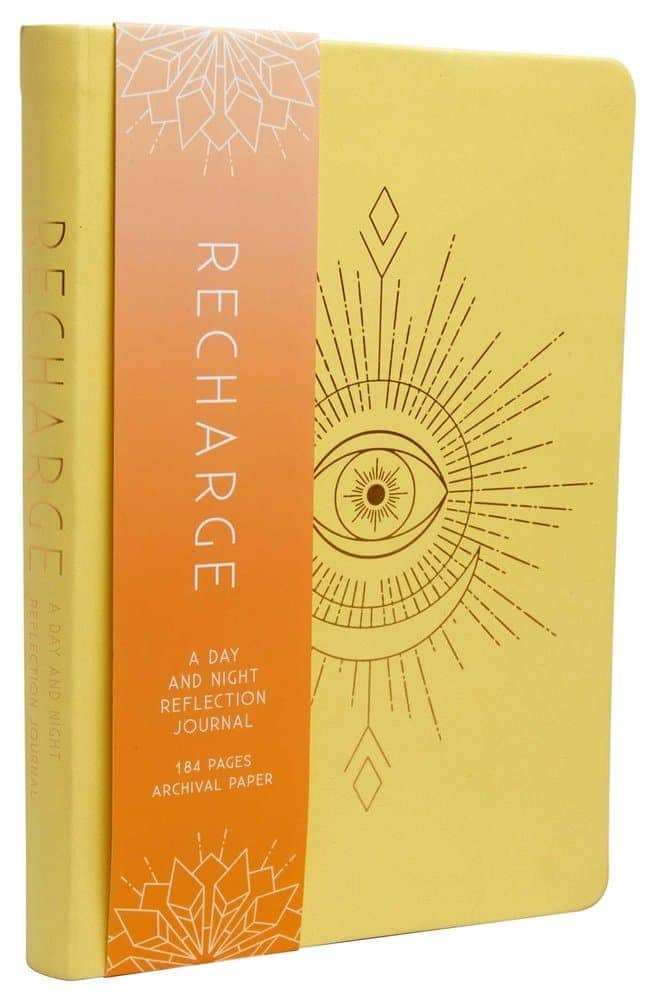
Recharge Journal by Insight Editions
Recharge your energy and avoid burnout with a simple daily routine that actually fits your life.
Did you know? By buying from Bookshop.org, you help support independent bookstores.
Final Thoughts
Looking back, I don’t think being highly sensitive was ever the biggest challenge. The biggest challenge was believing all the wrong things about it.
I spent years trying to fix a personality trait that didn’t actually need fixing. What needed to change wasn’t my sensitivity. It was the way I understood it.
If you recognized yourself in any of these myths, I hope you’ll be a little kinder to yourself moving forward.
- Being highly sensitive doesn’t mean you’re weak.
- It doesn’t mean there’s something wrong with you.
- And it certainly doesn’t mean you’re incapable of building a happy, successful, meaningful life.
It simply means you experience the world a little differently.
For me, understanding that has been incredibly freeing. These days, I don’t see my sensitivity as something I need to hide. I see it as one of the qualities that has shaped the person I’ve become.
And honestly?
I wouldn’t want to lose that part of myself.
Because while sensitivity has certainly made life more challenging at times, it’s also made my life richer, more meaningful, and far more beautiful than I ever realized.
*This article is for informational and educational purposes only and should not be considered a substitute for professional mental health advice. If you are experiencing emotional distress or mental health challenges, please seek guidance from a licensed therapist or mental health professional.
Aron, Elaine, Ph.D. “Author’s Note, 2012, for the highly sensitive person.” Highly Sensitive Person, https://hsperson.com/pdf/Authors_note_HSPbk_Preface.pdf. Accessed 31 August 2023.
Aron, Elaine, Ph.D. “Introversion, Extroversion and the Highly Sensitive Person.” Highly Sensitive Person, 24 April 2018, https://hsperson.com/introversion-extroversion-and-the-highly-sensitive-person/. Accessed 31 August 2023.
Acevedo, Bianca P et al. “The highly sensitive brain: an fMRI study of sensory processing sensitivity and response to others' emotions.” Brain and behaviorvol. 4,4 (2014): 580-94. doi:10.1002/brb3.242. Adapted and used under the Creative Commons Attribution 4.0 International License.
Acevedo, Bianca P., Aron, Elaine N. et al. “Sensory processing sensitivity and its relation to sensation seeking.” Current Research in Behavioral Sciences, Volume 4 (2023) 100100. https://doi.org/10.1016/j.crbeha.2023.100100. Adapted and used under the Creative Commons Attribution-NonCommercial-NoDerivs 4.0 International License.
Gulla, B., & Golonka, K. "Exploring Protective Factors in Wellbeing: How Sensory Processing Sensitivity and Attention Awareness Interact With Resilience." Frontiers in Psychology, vol. 12, 751679, 2021, doi: 10.3389/fpsyg.2021.751679. Adapted and used under the Creative Commons Attribution 4.0 International License.
Ioannou, M., Olsson, S., Bakken Wold, A., Dellepiane, M., & Steingrímsson, S. "Approaching 'highly sensitive person' as a cultural concept of distress: a case-study using the cultural formulation interview in patients with bipolar disorder." Frontiers in Psychiatry, vol. 14, 2023, article 1148646. doi: 10.3389/fpsyt.2023.1148646. Adapted and used under the Creative Commons Attribution 4.0 International License.
Lee, Oan Na, and Gyeong-A Park. "The Mediating Effects of Attachment Styles on the Relationship between Sensory Processing Styles and Interpersonal Problems in Healthy University Students." Occupational Therapy International, vol. 2020, Article ID 6204120, 6 pages, 2020, https://doi.org/10.1155/2020/6204120. Adapted and used under the Creative Commons Attribution 4.0 International License.
Morellini, Lucia et al. “Sensory processing sensitivity and social pain: a hypothesis and theory.” Frontiers in human neuroscience vol. 17 1135440. 14 Jun. 2023, doi:10.3389/fnhum.2023.1135440. Adapted from and used under the terms of the Creative Commons Attribution 4.0 International License.
Rajmohan, V, and E Mohandas. “The limbic system.” Indian journal of psychiatry vol. 49,2 (2007): 132-9. doi:10.4103/0019-5545.33264. Adapted and used under the Creative Commons Attribution 4.0 International License.
Tay, Shu Wen et al. “Systems 1 and 2 thinking processes and cognitive reflection testing in medical students.” Canadian medical education journal vol. 7,2 e97-e103. 18 Oct. 2016, https://www.ncbi.nlm.nih.gov/pmc/articles/PMC5344059/. Adapted and used under the Creative Commons Attribution 2.0 Generic License.
Turjeman-Levi, Y., & Kluger, A. N. "Sensory-processing sensitivity versus the sensory-processing theory: Convergence and divergence." Frontiers in Psychology, vol. 13, 2022, article 1010836. doi: 10.3389/fpsyg.2022.1010836. Adapted and used under the Creative Commons Attribution 4.0 International License.

Malin, co-founder of Courier Mind, is passionate about personal growth and mindset. With a focus on self-discovery and goal-setting, she creates content that inspires confidence, balance, and growth for the mind and spirit.